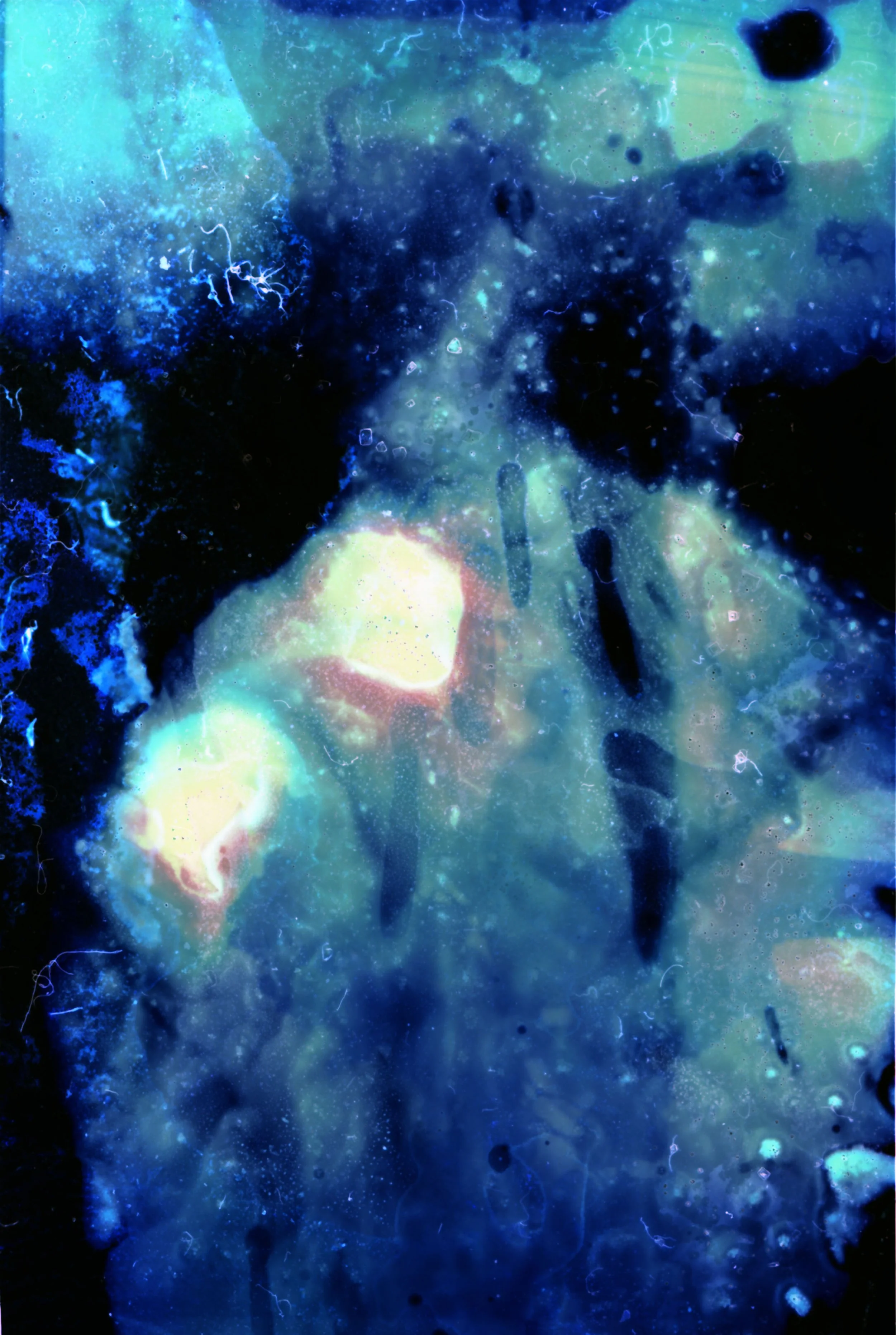
Bleach, 2010
When I first began working with photography, I had just relocated to Tennessee. I felt completely lost—uprooted and out of place. I was introduced to photography through the darkroom, where creating a successful image depends on the perfect environment: a careful balance of temperature, chemicals, and light.
I began to hypothesize what would happen if that environment was disrupted. What would my photographs look like if they, too, were uprooted? What if their surroundings were unfamiliar or unstable? This question became the foundation of my process. What if I printed an image incorrectly? What if the studio became visible within the photograph? What if I reloaded the film mid-process?
I began to think about photography in its most literal sense—as the capture of light. I used moving water to fracture and redirect light, both within the subject and within the chemical baths themselves.
Disrupting the process—the expectations and the rules—gave me a sense of control during a time when I felt I had very little. My images became micro-studies: the movements of water and paint, the glitches of a printer struggling with an oversized image, the lapses in developed film, and the chemical burns left behind by experimentation.